
J hooks & eye Hooks
About The Product
Armour Rods and Preformed Fittings are essential components used in overhead transmission and distribution lines. They are designed to protect conductors from mechanical stress, electrical discharge, and environmental damage, thereby enhancing line reliability and reducing maintenance.
An eye hook typically refers to a metal rod with a closed loop (eye) at the end instead of a J-shaped curve. Eye hooks are used to connect guy wires, stay sets, or other components to structures or poles safely.
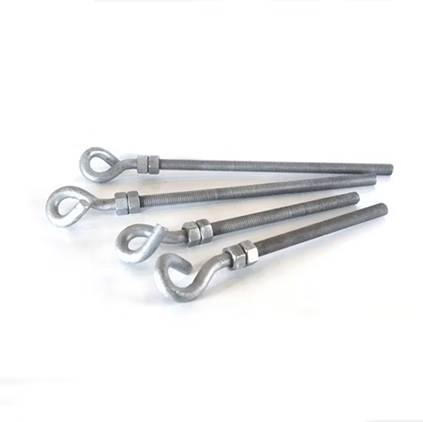
featueres
1. Durability:
Usually made of forged or high-strength steel with hot-dip galvanization for resistance to corrosion.
2. Weather resistance:
Suitable for outdoor service under heavy rain, strong winds, or freezing conditions.
3. Safe and reliable:
Provides strong mechanical connection for securing conductors or stay lines safely.
4. Versatility:
Comes in numerous sizes and configurations to match different load and structural requirements.
Size & range
1. Thread Size: typically M12, M16, M20
2.Rod Thickness: 10 mm–20 mm
3. Eye Diameter: 20 mm–50 mm
4. J Hook Gap:30 mm–100 mm
5. Overall Length: 100 mm–500 mm or even more, depending on application
6. Load Capacity: range from 0.5 kN up to 10 kN or greater
usage
J-Hook:
1. Support for service drops
2. Suspensions for secondary conductors
3. Connection to insulators or brackets
4. Often used on distribution poles or cross-arms
Eye Hook:
1. Connection point for stay wires or guy lines
2. Support for heavy-load anchors
3. Fixed into structures to aid in tension resistance
Standarization
1. IS 2486 (Part I & II) — General hardware for overhead lines in India
2. IEC 60383 — Insulators and related hardware
3. ASTM A307 — Carbon Steel Rods and Hooked Rods
4. Local utility standards (depending upon country and utility regulations)
application
1.Distribution lines:
Supporting service drops, secondary lines, and messengers.
2. Guy lines:
Eye hooks used to anchor or connect to stay wires.
3. Dead-ends:
J-hooks used in securing down-up lines or for corner structures.
4. General utility structures:
For securing and guiding wires and other components safely.
installation
➥ Placement: J-hooks are typically anchored into wooden or metal cross-arms or directly into utility poles with heavy-duty bolts. Eye hooks are anchored to structures with a nut-and-washer combination.
➥ Safety measures: 1. Proper torque to avoid over-tightening
2.Use appropriate washers
3.Inspection after installation to assure stability
4. Maintain proper clearances per standards and utility guidelines